

Diversity of planktonic coMmunities and dissolved organic carbon in upwelling coastal areas: from Satellite to Omics (MiSaO)
PROJECT OVERVIEW
MiSaO is an interdisciplinary research project that investigates how prokaryotic organisms (bacteria and archaea) respond to changes in the quantity and quality of organic matter in coastal upwelling systems. By combining satellite Earth Observation, molecular biology techniques, in situ measurements, and artificial intelligence, MiSaO aims to improve our understanding of the functioning of coastal marine ecosystems under the impacts of climate change and increasing human pressures.
The project focuses on the relationships between dissolved organic matter and microbial plankton communities, which play a key role in marine food webs, the carbon cycle, and climate regulation.
WHY COASTAL MARINE ECOSYSTEMS MATTER?
Coastal ecosystems cover less than 10% of the Earth’s surface, yet they support a substantial share of global marine productivity and biodiversity. They provide essential ecosystem services, including food provision, climate regulation, and coastal protection. Given their importance, it is no coincidence that nearly half of the world’s population lives in areas close to the coast.
However, coastal marine ecosystems are among the environments most vulnerable to climate change and human activities. Rising ocean temperatures, eutrophication, and increasing inputs of organic matter are altering light conditions, food webs, and biogeochemical cycles. These changes have significant impacts on microbial plankton communities, which form the foundation of marine ecosystems and regulate carbon fluxes between the ocean and the atmosphere.
Understanding these processes is essential for predicting how marine ecosystems will respond to global change and for developing sustainable coastal management strategies that balance ecological conservation with socioeconomic development.
OBJECTIVES AND KEY RESEARCH QUESTIONS
The main objective of MiSaO is to develop a novel approach to describe the spatial and temporal dynamics of the diversity of both present and metabolically active prokaryotic plankton communities and their relationship with dissolved organic matter, by integrating satellite, physicochemical, and genetic observations in coastal upwelling systems.
The project will address the following key research questions:
The project will address the following key research questions:
1.
Can satellite observations be used to estimate coloured dissolved organic matter (CDOM) and its relationship with dissolved organic carbon (DOC) in coastal marine waters?
2.
Can the spatio-temporal patterns of prokaryotic communities be identified using satellite-derived variables (CDOM and DOC) in combination with environmental DNA (eDNA) monitoring?
3.
Does the combination of DNA- and RNA-based molecular approaches improve the detection of active microbial communities?
4.
Can models developed in a specific upwelling system be transferred to other regions under different environmental conditions?
Study Areas
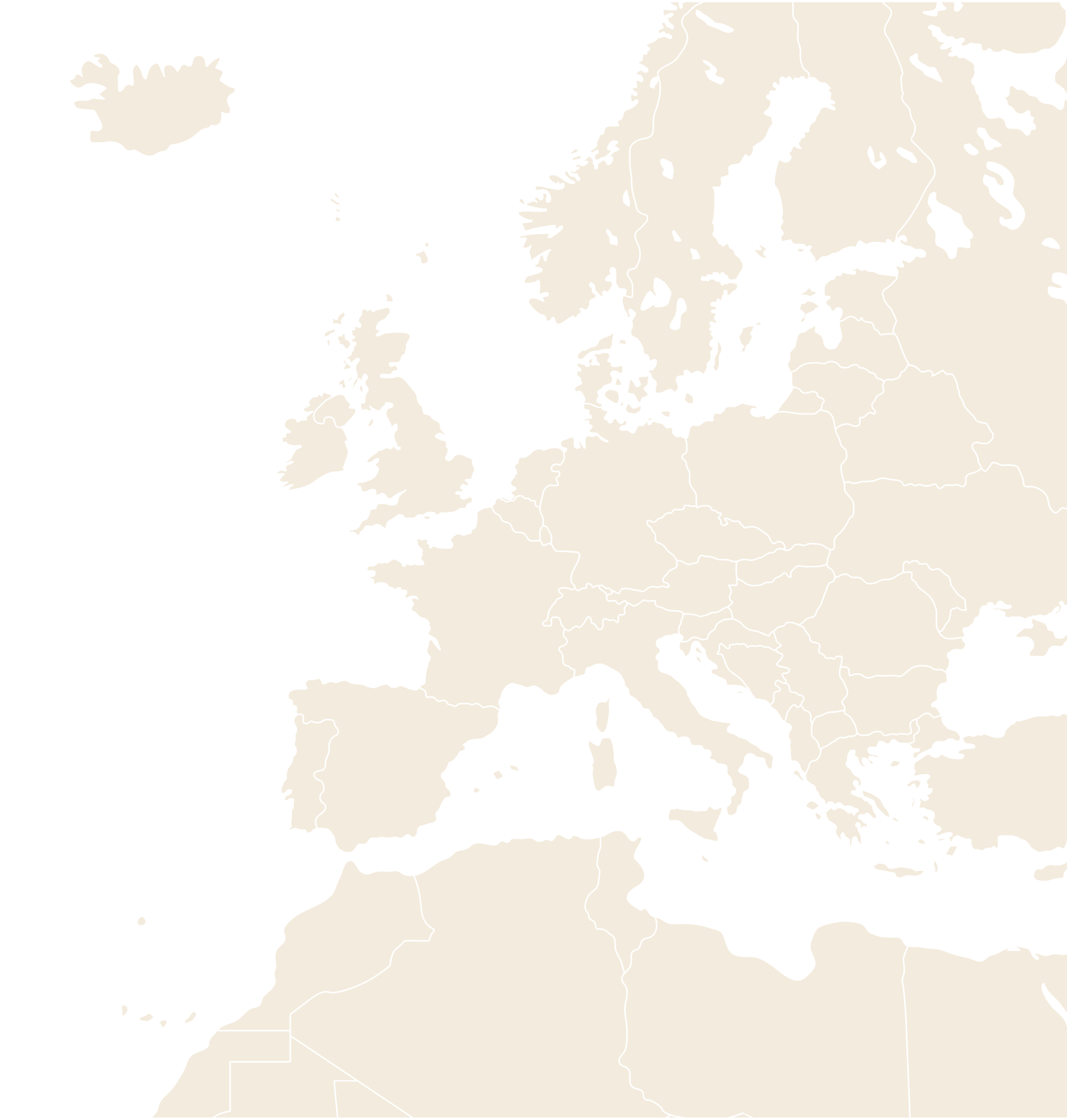
The MiSaO project is conducted in three contrasting coastal regions that are representative of different marine upwelling systems:
Golfo Ártabro - Northwestern Iberian Peninsula
MiSaO is linked to the RADIALES time-series programme, a multidisciplinary observing system that collects oceanographic and biological data on a weekly and monthly basis. These observations enable the study of ocean variability and plankton communities (both eukaryotic and prokaryotic), with particular emphasis on the influence of changes in upwelling systems.
Canary Islands
The Canary Islands are located within the Northwest African Upwelling System, which is characterized by the presence of intense upwelling filaments. Unlike many other upwelling regions, this system is strongly influenced by the archipelago itself, which generates complex mesoscale circulation patterns. The seven main islands form part of the coastal transition zone connecting the African continental shelf with the open waters of the North Atlantic subtropical gyre. Interactions between the Canary Current and the trade winds promote strong mesoscale variability and shape the biological and biogeochemical processes of the region.
MiSaO data collection is linked to the RAPROCAN time-series programme, an oceanographic monitoring programme in the Northwest African coastal upwelling region. This programme conducts biannual surveys to investigate the hydrography, biogeochemistry, and prokaryotic communities of the marine ecosystem.
Baltic Sea
The Baltic Sea is a semi-enclosed, brackish, and relatively shallow coastal sea, with an average depth of approximately 55 m and pronounced latitudinal gradients in salinity and coloured dissolved organic matter (CDOM). Large river catchments discharge into the sea, while exchange with the open ocean is restricted through the Danish Straits. This limited water renewal, together with high nutrient loads, has led to persistent water-quality problems, including intense phytoplankton blooms and extensive low-oxygen areas.
Coastal upwelling, driven by winds blowing parallel to the shoreline, plays a key role in the distribution of temperature, salinity, nutrients, and phytoplankton. Along the Estonian coast, where most MiSaO activities are concentrated, upwelling events are frequent due to the predominance of southwesterly winds.
Methodological Approach
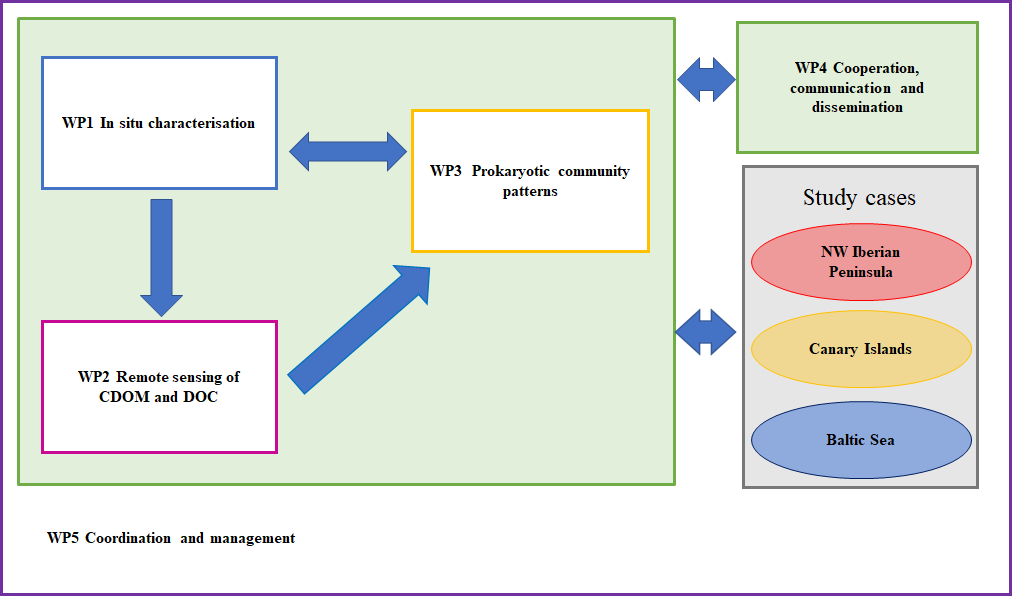
MiSaO is structured into five interconnected Work Packages (WPs): three focused on research activities, one dedicated to cooperation, communication, and dissemination, and one focused on project coordination and management.
WP1.
In situ characterisation.
This WP focuses on the in situ and laboratory characterisation of coloured dissolved organic matter (CDOM), dissolved organic carbon (DOC), and prokaryotic plankton communities. These data provide detailed information on water-column properties and microbial community structure, forming the basis for the calibration, validation, and optimisation of remote-sensing products, as well as spatio-temporal distribution models of marine prokaryotic plankton. Historical datasets are integrated with new observations collected through dedicated field campaigns.
WP2.
Remote Sensing of CDOM and DOC
This WP evaluates the potential of Sentinel-2 satellite data to derive CDOM and DOC in optically complex coastal upwelling systems. Particular attention is given to challenges such as atmospheric correction, the presence of multiple optically active constituents (e.g. chlorophyll), and bottom effects. The objective is to assess the feasibility and accuracy of remote-sensing-based approaches in dynamic coastal environments.
WP3.
Patterns of prokaryotic communities.
This WP investigates the spatial and temporal patterns of diversity in present and metabolically active prokaryotic plankton communities. By integrating eDNA and eRNA metabarcoding data, satellite-derived products, and key environmental drivers such as CDOM, temperature, and salinity, this WP assesses the factors shaping microbial community structure. The results will provide the basis for developing spatio-temporal distribution models of prokaryotic diversity and activity, while improving our understanding of their biogeochemical role in coastal marine environments.
WP4.
Cooperation, communication and dissemination.
This WP is dedicated to the communication, dissemination, and outreach of project results to the scientific community, institutions, stakeholders, and society at large through a range of channels and tools to maximise impact and knowledge transfer.
WP5.
Coordination and management.
The main objective of this WP is to ensure the effective coordination and management of the project and its activities, enabling the achievement of project objectives efficiently and within the established timeframe.
×
Expected Impact
MiSaO will advance our understanding of how coastal microbial communities respond to environmental change and how organic matter influences the marine carbon cycle. The project will provide new tools and knowledge for monitoring and modelling coastal ecosystems through the integration of satellite data and molecular techniques.
By supporting ecosystem-based management strategies and climate change adaptation measures, MiSaO will contribute to the sustainable use and conservation of coastal marine ecosystems in the context of accelerating global change.